
What Responsible Pet Care Really Costs
We love animals. That’s why we’re here. We want people to have, love, and care for their pets. We know the joy and companionship that they bring to our lives, and that’s something you can’t put a price on.
But what you CAN put a price on is responsible pet ownership.
Getting a pet is exciting, fun, fulfilling – but it’s also a serious responsibility. Having a pet means more than picking out a collar and a bag of food. It means toys and bedding, training, pet-sitting/boarding, grooming, parasite prevention, and veterinary bills – both routine and unexpected!
We know there are real barriers to accessing vet care: rising costs, vets that are not taking new clients, long distances to the nearest office. We’re working on solutions every day, and in the meantime we have programs like our Pet Food Pantry, Stitch in Time, and Hardy’s Friends.
You can read about those programs here, but the bottom line is: we are helping as many people as we can while we work on bigger, better solutions. But at the end of the day we are a small nonprofit. We rely primarily on public donations. We have finite resources. We can’t help everyone, as much as we want to.
We want people to experience the joy of a pet.
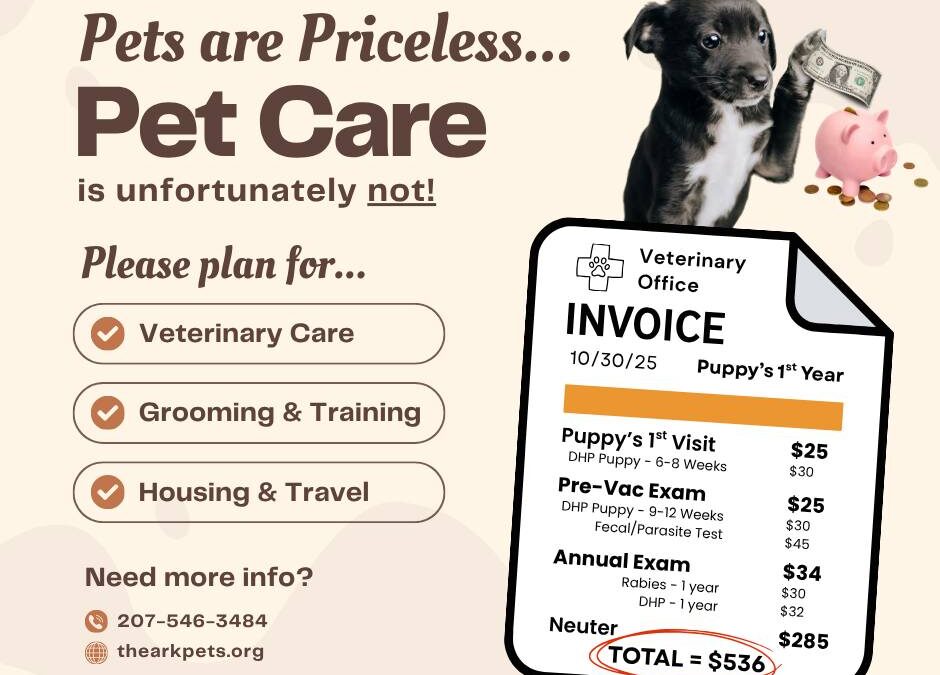
We truly do. But we also want people to go into pet ownership with eyes wide open. A local vet provided us with some live estimates for a puppy or kitten’s first year of care. For a healthy puppy, the first year of veterinary care (including exams, core vaccines, fecal testing, and spay/neuter) averages between $530 and $660. For a healthy kitten, that range is roughly $375 to $465. (Did you know? Females cost more to spay!)
That assumes everything goes 100% smoothly. It doesn’t include flea/tick preventatives, bloodwork, microchipping, or common medical issues like ear infections, allergies, or injuries.
Vaccines protect pets from serious, contagious, and sometimes fatal diseases. They are one of the best investments you can make for your pet’s health, and for your peace of mind.
📍That brings us to the reason for our educational post today.
We are seeing parvovirus – both locally and across the state. This is a deadly disease that fortunately, we were somewhat insulated from in Maine. That is over. Dogs are getting sick and dying. It is incredibly contagious. The symptoms are brutal. Treatment is expensive, round the clock, and requires impeccable quarantine conditions.
Parvovirus attacks the intestinal tract and bone marrow of dogs. Puppies and unvaccinated adult dogs are most at risk. It typically sets in 3-7 days after exposure. Symptoms can look like: lethargy, lack of appetite, fever, abdominal pain, vomiting, diarrhea (bloody), collapse, elevated heart rate, difficulty breathing.
Treatment of parvo is intensive (often hospitalization, IV fluids, antibiotics, multiple days of care) and thus very expensive. The cost of decontaminating the environment and isolating a pet adds time, stress and resources.
The virus is shed in feces during active infection and up to several WEEKS after recovery. It can linger on surfaces, in soil, etc. It can survive outdoors for months (even years in ideal conditions). Because of this, strict quarantine and disinfection are vital to contain outbreaks.
Preventing parvo via vaccination is far less costly than treating the disease.
Skipping vaccinations or delaying care is not “savings” – it is putting your pet (and other pets) at risk of serious illness, higher costs, distress and heartbreak.
If cost is a barrier, there are programs that can help, and you can find low-cost vaccination and spay/neuter clinics, like Maine Animal Health Alliance in Augusta. We realize these solutions have limited availability and don’t work for everyone, but they can and do help many.
We believe in giving pets the care they need and helping pet owners succeed in caring for their animals. That includes education. If you are considering bringing a pet into your home, bring them home with confidence built on knowledge. We’re here for you and we’re happy to help you on that journey.
Looking for affordable pet care resources?
Check out the link below to find local and state-wide options for low-cost vaccination clinics and spay/neuter services.